
Structures Simulation Enhancements in the R2026x Release | Dassault Systèmes
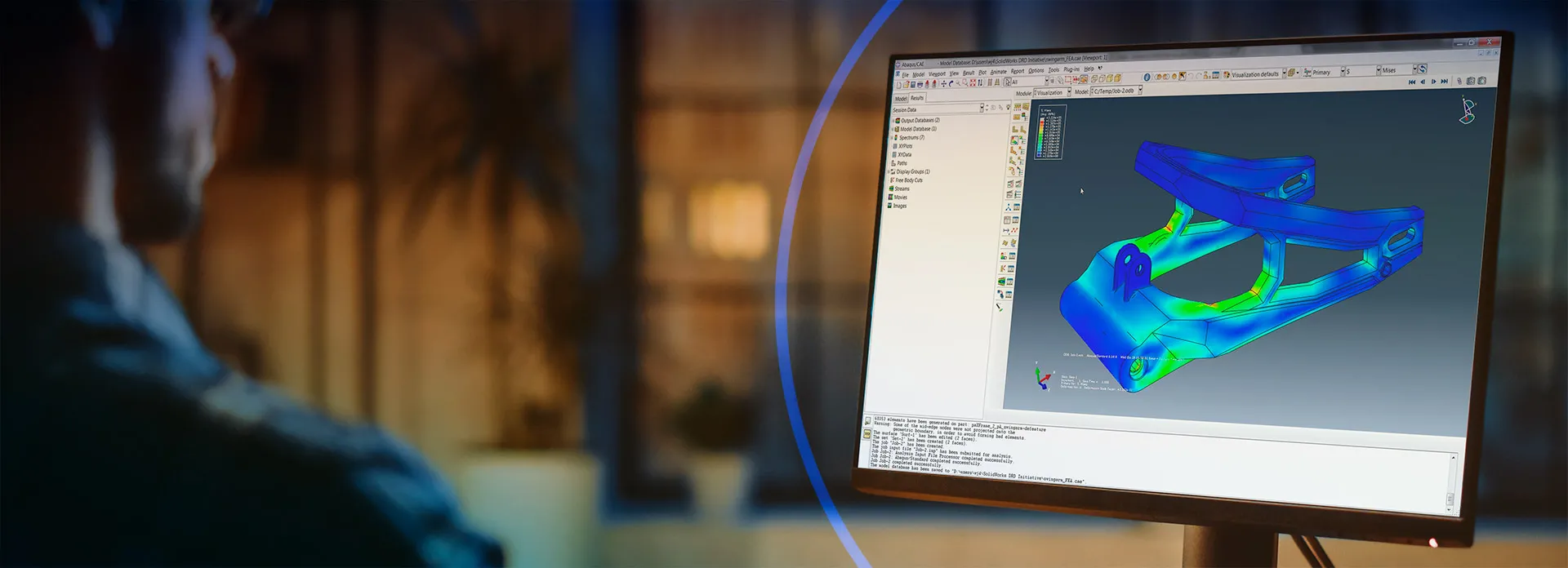
Discover an overview of the recent enhancements within the Abaqus solvers new features from the latest 2026x releases.
E-seminar
On demand
Finite Element Analysis for Mechanical Engineering and Civil Engineering
Abaqus is a leading finite element analysis (FEA) solution used by engineers to simulate the real-world behavior of products, materials, and assemblies under complex conditions. It is widely recognized for accurately modeling nonlinear phenomena such as large deformations, complex contact interactions, and advanced material behavior.
Abaqus enables analysts to predict how structures respond to realistic loading conditions such as impact, vibration, thermal effects, and material failure. Its robust implicit and explicit solvers support simulations ranging from detailed component analyses to large system-level models.
Abaqus is used across industries to simulate real-world behavior under complex conditions, enabling engineers to design safer, more reliable, and higher-performing products.
With increasing design complexity, the need for a detailed understanding of design intricacies becomes pivotal, leading to large simulation models. The Finite Element Analysis system must allow users to run large problems efficiently using available computer resources. Abaqus takes advantage of the high-performance features of modern computers, so the model size limitations rarely prevent you from realizing an adequate simulation.
Users appreciate being able to meet schedules because the code runs large, complex jobs through to completion. Realistic models quickly expose how meticulously the code designers handled the details. Abaqus holds up under the rigors of real-life, large model requirements.
Analysts must consider nonlinear responses as an essential part of a simulation. Lightweight structures buckle; in accident scenarios, they could collapse. Some important modern materials — like rubbers and plastics — are too soft to simulate based on linearized deformation. Often, the designer wants to take full advantage of the ductility and toughness of the materials available.
Many design problems involve contact. It could range from Hertz contact in bearing design to general sliding contact between a part and the die/mold used to form it. Or between two parts, each undergoing substantial deformation. Abaqus can address these types of complex problems. It has led to its worldwide reputation as the tool of choice for simulations where nonlinearity dominates the response.
Abaqus is popular as an advanced analysis code specializing in production analysis. It has a comprehensive suite of capabilities that are straightforward to learn. It is modular and has simple, consistent and intuitive problem definition rules that relieve you of artificial and frustrating limitations. Users can model geometry as closely as needed, define material behaviors associated with various components of the model and simulate a sequence of events of concern.
Abaqus is designed to ease complex tasks. One of the best examples is automatic time stepping in nonlinear static, dynamic and heat transfer problems: Abaqus chooses and continuously adjusts the time increments automatically. This feature alone has permitted many users to perform simulations that would have been impossible otherwise. Users can tackle realistic simulations with the confidence of success and assurance of meeting the design schedules.
Research organizations use Abaqus extensively because of its versatility and user-defined extensibility. Its great success arises from its acceptance in the design analysis community as a general analysis tool that provides convenience in routine simulations and greatly extends the range of possible simulations.
Abaqus has a proven record of success in the largest and most complex problems, which distinguishes it. Abaqus is a pleasure to work with for relatively straightforward applications. For complex problems, Abaqus shines as the most trusted tool that provides reliable answers.
Solution Technology for Linear and Nonlinear Finite Element Analysis
Solution Technology for Highly Nonlinear Transient Events
Complete Solution for Abaqus Finite Element Modeling, Visualization, and Process Automation
Complete Solutions for Realistic Simulation
Associative Interfaces Between Abaqus and CAD Systems
Advanced Model Build for Ply and Fiber Materials
Crush simulation for laminated composites
Abaqus continues to innovate with AI-driven automation, advanced optimization, and cloud-ready solutions. Explore the technological advancements, innovative methodologies, and evolving industry demands that are reshaping the world of Design & Engineering Simulation. Stay a step ahead with SIMULIA. Discover now.
Discover an overview of the recent enhancements within the Abaqus solvers new features from the latest 2026x releases.
E-seminar
Today with the release of 2026 FD01, Abaqus is introducing GPU acceleration for Explicit analyses. As far as I'm aware, this makes Abaqus the only major commercial explicit FEA code to enable users to leverage GPU compute. We're very excited to release this new capability - the culmination of a major effort within Abaqus R&D. That said, in some sense it's just the start of a journey, as we plan
SIMULIA COMMUNITY
Explore advances in solving nonlinear industrial optimization problems using Tosca Structure, Abaqus/Standard, and CST, with updates on multiphysics and Multi-DV optimizations.
E-seminar
This e-seminar will highlight the use of analysis checklists to systematically build more robust Abaqus models.
E-seminar
This Tech Talk will show some very interesting examples of Abaqus models of commonplace structures and talk about what we can learn from them.
E-seminar
Contact and Convergence in Abaqus/Standard The really interesting finite-element models, like the...
Article
In every industry, products are becoming more complex, and thus simulation must...
Article
Introduction Multiphysics technology has been a part of the Abaqus Unified FEA...
Article
Electrification is fundamentally reshaping vehicle engineering, making simulation at the battery cell level now a key factor in innovation. The shift from internal combustion engines (ICEs) to electric vehicles (EVs) has introduced new design challenges and heightened safety requirements. Modern engineering increasingly relies on Multiphysics simulation—from electrochemistry to structural analysis—to drive optimal cell, module, pack, and full-vehicle designs. Let us explore how different methodologies in battery cell engineering can improve the design of batteries for efficient electric vehicles (EVs).
Article
MicroElectroMechanical Systems (MEMS) have revolutionized the semiconductor market since their development in the early 1990s, now accounting for approximately 20% of the global market. Among these, Surface Acoustic Wave (SAW) devices stand out for their exceptional sensitivity and versatility in sensing applications. Our latest simulation study, utilizing SIMULIA Abaqus and SIMULIA CST Studio Suite, examines the performance analysis of a MEMS SAW gas pressure sensor, demonstrating a robust multiphysics simulation workflow.
Article
Materials provider Celanese harnesses virtual testing, simulation and validation to support continuous business improvements and address ever-increasing customer requirements.
Article
We spoke to Dr. Puneet Mahajan, Professor, Department of Applied Mechanics, IIT-Delhi, who discussed his research simulating the erosion and repair of wind turbine blades due to raindrop impacts, specifically looking at the blades’ life expectancy. He explores using Abaqus software to model the effects of high-intensity rain on the blades and predict stress patterns in wind turbine blades, including the effect of voids in the blade coating. The study also explores innovative repair techniques, such as UV curing, which significantly reduces repair time compared to traditional thermal methods. He also highlights the importance of validating simulation results with experimental data to ensure accurate predictions and improve the design and maintenance of wind turbines.
Article
Controlling noise, vibration and harshness (NVH) is crucial to meeting customer expectations in the automotive market. NVH has historically been investigated in the later stages of development, after physical prototypes have been constructed, and rework to fix NVH issues can be expensive and increase vehicle weight. In this blog post, we show how unified modeling and simulation (MODSIM) can reveal noise and vibration issues at any stage of development, allowing engineers to find and resolve problems before committing to a design, and to find the root causes of noise and vibration. MODSIM accelerates product development and reduces the risk of late-stage NVH problems.
Article
Innovative technologies like virtual twins are enabling some of the biggest brand names to create sustainable packaging solutions.
Article
This blog discusses gasket simulation in Abaqus/Standard, focusing on real-world applications. Gaskets provide cost-effective seals between mating surfaces and have applications across various industries.
Article
This blog is a comprehensive exploration of the process of debugging models in Abaqus/Standard, with a specific focus on resolving convergence issues. It provides a detailed comparison between Abaqus/Standard and Abaqus/Explicit, using iterative methods and strategies, highlighting the importance of understanding model features, adopting systematic approaches, and maintaining perseverance in the face of issues.
Article
Packaging for consumer goods has to meet many different requirements, including cost, weight, strength and sustainability. Machine learning enables packaging manufacturers to understand the impact of design changes much faster than traditional simulation methods allow, and to rapidly explore the entire design space to find innovative new packaging designs. AI-enabled unified modeling and simulation (MODSIM) is accelerating product development in the consumer packaged goods & retail industry and cutting manufacturing cost and product weight.
Article
This blog post was originally published in October 2020. We’ve got a...
Article
As a welded part cools down, residual stresses form within the part. The structural performance of a weld depends heavily on the parameters of the welding process, such as heat input, welding paths, and fixture designs. Simulation can model the weld process in order to calculate the residual stress distribution and deformation within welded submarine parts. This article explains how artificial intelligence (AI) and machine learning can be used to accelerate analysis and optimization of welds.
Article
SIMULIA is delighted to work with engineering leaders and academics as they leverage simulation capabilities to help shape the future of their industry. We had the opportunity to interview 4RealSim, a company specializing in high-end numerical analysis services. During the interview, we discussed how 4RealSim uses Abaqus in the SimInSitu EU project (http://www.siminsitu.eu/). SimInSitu aims to develop sophisticated in-silico methods to predict the short- and long-term behavior of in-situ tissue-engineered heart valves (TEHV) by combining advanced tissue remodeling algorithms with a personalized virtual heart modeling approach. The method will be specifically developed to predict the complex transformation process of biodegradable heart valves from the initially synthetic scaffold into a fully remodeled and functional valve.
Article
The recent webinar playback for Democratizing Engineering Analysis Through a Universal Material Subroutine with Dr. Ellen Kuhl from Stanford University and Dr. Mathias Peirlinck from Delft University of Technology is now available in the SIMULIA Community. Listen as they share their expertise on democratizing engineering analysis through a universal material subroutine.
Article
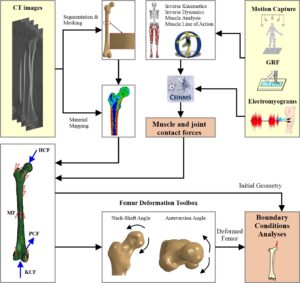
Hear from SIMULIA Champion, Professor Stefanie Feih of Griffith University, about how orthopedic surgical planning can now leverage patient-specific neuromusculoskeletal models to determine physiologically plausible muscle and joint contact forces comprising points/areas of application, magnitude, and direction. Finite element analysis (FEA) is subsequently employed to estimate stresses and strains in the implants and their host tissues throughout the complete gait cycle. These simulations, or digital twins, may facilitate validated implant designs and surgical placement, leading to improved surgical outcomes.
Article
Simulation is a powerful tool that health care professionals can leverage to analyze patient data at the tissue level.
Article
Engineering Software from SIMULIA
Finite Element Analysis for Mechanical and Civil Engineering
Speak with a SIMULIA expert to learn how our solutions enable seamless collaboration and sustainable innovation at organizations of every size.
Courses and classes are available for students, academia, professionals and companies. Find the right SIMULIA training for you.
Find information on software & hardware certification, software downloads, user documentation, support contact and services offering