
Transforming Infrastructure & Cities for Your Business and Their Future

#29: What Bold Solutions Can Decarbonize Rail Freight?
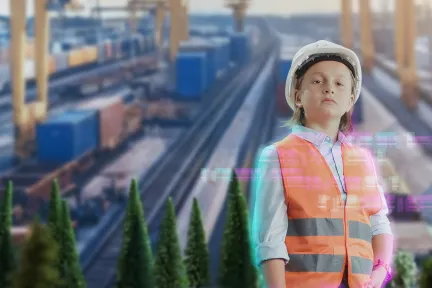
Join 9-year-old Infrastructor Bernardo as he explores how virtual twins enable bold energy solutions to decarbonize rail freight.
#29: What Bold Solutions Can Decarbonize Rail Freight?
9-year-old Infrastructor Bernardo teams up with logistics expert Muthu Sivanantham to uncover how virtual twins drive rail freight decarbonization. Discover innovative energy solutions such as hydrogen, batteries and hybrid systems, and learn how these technologies can reduce emissions, optimize operations and transform the future of logistics.
This episode is part of the Infrastructors project. Click here to find out more.
Meet our speakers


There's a huge potential to decarbonize the remaining 75% of the rail freight segment that uses diesel as its primary fuel. Just to quote – this is coming from a rail industry OEM – a diesel locomotive emits around 30,000 tons more carbon dioxide per year than its battery equivalent.”
Muthu Sivanantham
Read the transcript
Narrator: Welcome back to Disruptors Unleashed, where we explore bold, disruptive ideas and chat with the trailblazers who are redefining industries as we know them. In our previous episode, we looked at how connected solutions deliver future-ready operations with Mike Bradford from Dassault Systèmes.
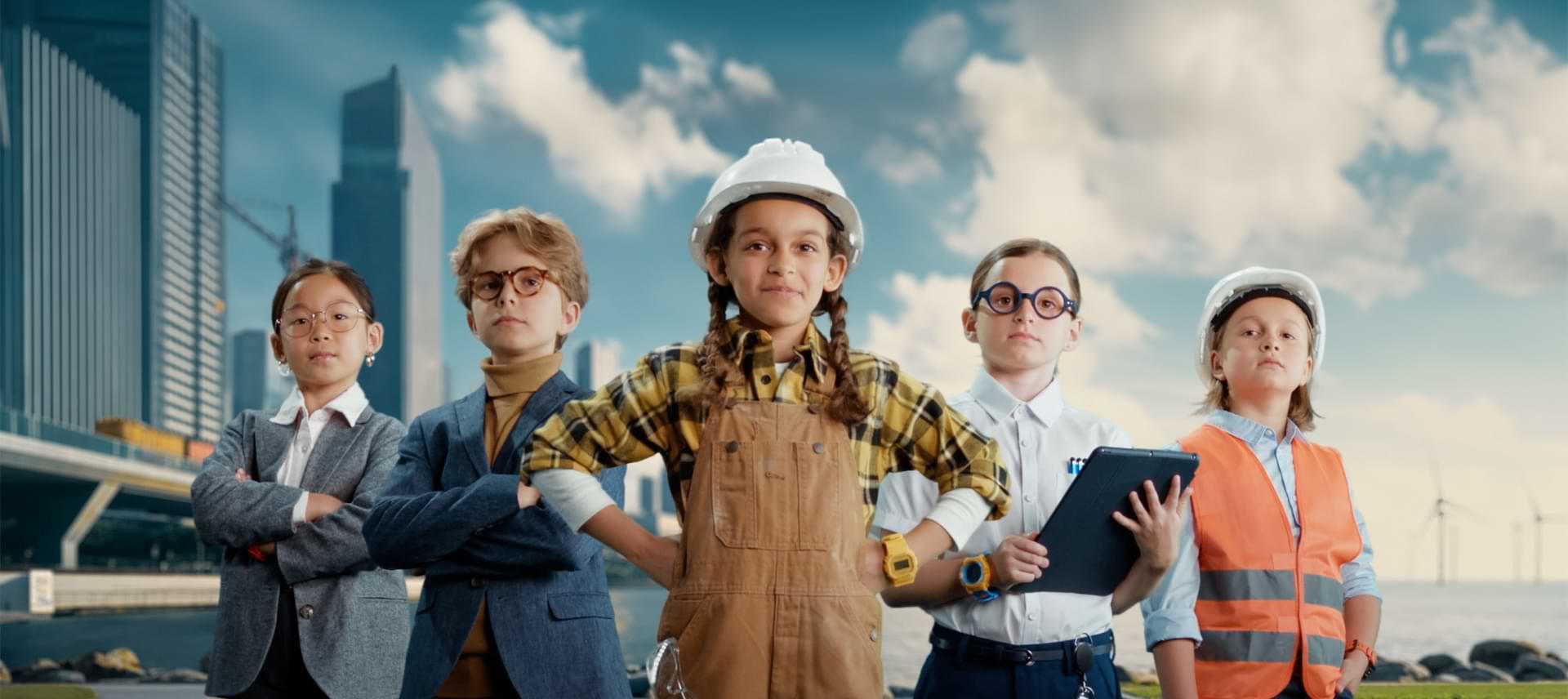
Today, we’re kicking off a brand-new miniseries featuring our very own Infrastructors. The Dassault Systèmes Infrastructors are the small but mighty engineers, builders and designers of tomorrow who are asking the big questions, like how can our infrastructure and cities change to tackle the challenges of today and tomorrow?
I’d like to welcome a special guest, 9-year-old Bernardo, who’s a big train fan. He’ll be speaking with Muthu Sivanantham, who’s one of our leading experts on the topic of logistics and rail freight.
Today, they’ll discuss the huge sector that is logistics, and, particularly, how we can decarbonize one of its most promising modes of transportation: Rail freight. Over to you, Bernardo!
Muthu Sivanantham: Nice to meet you, Bernardo. My name is Muthu Sivanantham. I’m one of the industry solution leaders at Dassault Systèmes. I work very closely with our rail freight and logistics customers.
Bernardo: Hi Muthu, I also love trains. I especially love how fast they go! But I’ve always wondered what makes them go so fast.
Muthu Sivanantham: Close to 75% of freight trains that move our goods around the world today fall into the category of diesel-driven propulsion. Now, most of the real speedy ones – aerodynamically designed passenger trains that literally fly across – are called Maglev, which is based on magnetic levitation. Even without the magnetic levitation (think of the Shinkansen, the TGV or the Eurotunnel train), the majority of them, almost all of them, are powered by electricity. They get the energy – electrical energy – from special lanes above the tracks or sometimes on the side. It’s almost like plugging this entire system into a huge power socket.
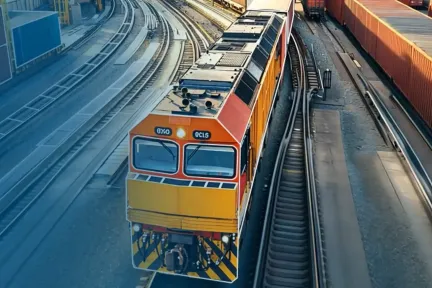
And guess what? There are even newer kinds of trains joining the party, especially in the rail freight segment. Some are like giant remote-controlled cars — they’re powered by huge batteries and can run without any diesel. All they need is a very good charge, and some are even starting to use hydrogen.
But these newer kinds of energy are unfortunately used only by the remaining 25% of the rail freight segment. Some of them, because of practical reasons, even use a combination of one or more energy sources, such as diesel with hydrogen, diesel with battery and so on.
Muthu Sivanantham: The underlying fact is, most of the trains today are electric-ready. They’re traction-ready. They all have a smaller battery – not a huge battery – but they can be easily retrofitted. For example, the current diesel version can be retrofitted to a bigger battery version, or it can be retrofitted to add hydrogen as a fuel.
And of course, you know, newer standards and technologies come with new challenges too, right? We have to worry about thermal runaway and fire hazards, let alone really high pressure. Hydrogen operates at 700 bar, which is a really high-pressure environment. If something happens, some untoward incident, we have to consider these factors on top of battery aging and battery longevity. These are some challenges that we need to account for.
But guess what? They also come with a lot of additional benefits. In addition to having less emissions and being less polluting, they can also conserve energy, for example, through regenerative braking. When it comes to going downhill or whenever they brake, that energy, instead of losing it as heat, can be put back into batteries.
Bernardo: Wow, that’s really cool, but it also sounds super complicated.
Muthu Sivanantham: That’s an excellent question as well, Bernardo. As we saw, there’s a huge potential to decarbonize the remaining 75% of the rail freight segment that uses diesel as its primary fuel. Just to quote – this is coming from a rail industry OEM – a diesel locomotive emits around 30,000 tons more carbon dioxide per year than its battery equivalent.
Bernardo: Wow, that’s a lot! But I guess that’s also a big opportunity for those looking to transition?
Muthu Sivanantham: Yes. I mean, we definitely know there’s a lot of potential if we electrify the remaining 75%, right? At the same time, it’s also very, very cost-prohibitive. To electrify the entire North American rail freight network, it’s estimated to cost more than $1 trillion USD in completely new investments that have to be borne by the Class I railroads — the rail operators. Most of them are private companies, and they have no incentive to spend a trillion dollars for some benefits they’ll get far down the line.
These estimates are coming from the AAR — that stands for the American Association of Railroads. So, it’s literally not practical. It’s very, very cost-prohibitive to completely electrify the network.
That’s why operators worldwide are looking at battery-based or hydrogen fuel cell-based locomotives, especially in areas with smaller geographies or terrains where there is some good charging available, or for hydrogen use cases, some refueling stations where such infrastructure is available or can be made available.
Bernardo: That sounds good – if you live somewhere with the right infrastructure...
Muthu Sivanantham: The other, more practical option is to retrofit existing locomotives and supplement the current diesel fuel with a battery or hydrogen-based energy system, which makes them hybrid. At the same time, they can still significantly reduce the carbon dioxide and particulate emissions they’ll end up putting out to the environment.
Bernardo: Okay, that’s a couple of good options, so how can we get those wheels turning?
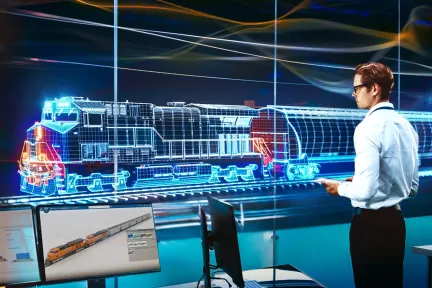
Muthu Sivanantham: The good news is, irrespective of whichever new propulsion method our customers choose, Bernardo, Dassault Systèmes’ virtual twin experiences can support their journey, irrespective of whether they’re doing advanced simulation, analysis, planning or optimization. We can go across a rail freight segment’s entire lifecycle, be it the design area, the manufacturing department or if they’re looking into the automation of their networks. Maybe they want to solve their supply chain challenges and optimize their supply chain. Some of these rail operators are heavily using intermodal automation.
Bernardo: Intermodal?
Muthu Sivanantham: Intermodal is a method where the same containers or goods go from sea to rail to land and vice versa. They also have to deal with last-mile delivery in some other cases. Anyway, if you want to look at the entire lifecycle, whether it’s 1D, 2D – today, the new energy modeling boundary condition (BC) is solved through a 2D solution called CATIA Dymola on our platform – or even full-blown 3D, our unified 3DEXPERIENCE® platform houses all these solutions under one roof. They can go from new energy modeling to aerodynamic modeling, aerodynamic analysis to rail derailment analysis, or deeper hydrogen-based fuel cell analysis. All those results can be plugged back into the platform, where further optimization of these alternative energy systems can be evaluated.
Bernardo: Wow, the sustainability benefits here seem amazing – and not just for rail but for all transport, right?
Muthu Sivanantham: The greener solutions we’ve talked about thus far for the rail freight segment can save us anywhere between 150 to 200 million metric tons of carbon dioxide emissions globally.
Bernardo: Woah!
Muthu Sivanantham: And in terms of numbers, I was recently reading an MIT Climate Portal analysis where they were clearly listing rail as contributing around 170 million metric tons of carbon dioxide emissions. At the same time, like you mentioned, for other modes of transport, there are various types of freight that emit carbon dioxide, and they’re not necessarily the ones carrying the majority of the cargo.
Let me explain that a little bit better. For example, sea freight carries almost nine times more cargo than rail. Yet, for that amount, it still emits significantly less carbon dioxide. Just for comparison, rail emits about 170 million metric tons, while sea freight – despite transporting nine times more cargo – emits around 650 million metric tons of carbon emissions.
Bernardo: So, let me get that straight — that’s four times the CO2, but about nine times the volume of freight?
Muthu Sivanantham: The point being, using our virtual twin-based new energy modeling solution, the same ideas can be applied to sea freight as well. Today, around the globe, there are alternative propulsion methods that sea freight operators are evaluating. They’re looking at wind-assisted propulsion. They want to use green ammonia as a fuel — either to supplement or even replace their current fuel systems. Of course, they also want to deploy green hydrogen. And of course, new energy-based, battery-based ideas are always being evaluated, piloted and even used.
Not so far in the future, they could be piloting or testing nuclear energy-based SMRs – small modular reactors – that can be utilized in sea freight as well. So, the idea is that whatever kind of new energy it may be, our new energy modeling solutions can help these operators, both in rail freight and sea freight, to run multiple what-if scenarios for these energy models.
Muthu Sivanantham: For a rail freight case, how do my rail consists perform when I go up the hill versus down the hill? What kind of battery state of charge will it retain across the various terrains? What would be the carbon dioxide and particulate matter emissions coming from each one of the models that I want to study? All these studies can be done. And these studies can help analyze, forecast and achieve up to 30% reduction in rail freight operators’ energy expenses, which typically come from diesel usage alone. And this is almost 14-20% of their overall operational costs. So, when we say substantial, yes, we could really impact it substantially.
Additionally, another piece of information is that they can also collaborate with their suppliers and original equipment manufacturers when it comes to supplying alternate energy systems, locomotives and subsystems to them. Now they can do meaningful collaborative exercises.
So, to sum it all up, we know that around 80% of global goods today are moved either by sea or by rail. If you set aside the other 20%, which mainly come from road transport and a little bit from air transport, both of them are still polluting. But even if we leave them aside for now, we have the power and capability to influence almost 80% of the goods that move around the globe today and have our customers weigh the benefits and ask: Is it a new energy or hybrid system that makes sense for my operations?
Bernardo: Wow, that’s amazing! I’ll certainly be thinking about this next time I use the train! Thanks so much for coming on and sharing with us today, Muthu!
Muthu Sivanantham: It was really lovely talking to you, Bernardo. Thank you so much.
Bernardo: Anyway, back to you, Yani!
Narrator: Thank you, Bernardo and Muthu, for that insightful conversation! Tune in to Disruptors Unleashed if you’d like to hear from other Infrastructors on the biggest challenges impacting our infrastructure and cities. ‘Til next time!
Disruptors Unleashed is produced by Dassault Systèmes. For more episodes, follow us on Apple Podcasts, Spotify, Deezer, or your nearest audio streaming platform. To learn more about Dassault Systèmes, visit us at 3ds.com.
Learn More
Discover how integrated planning and scheduling solution helps you optimize daily freight rail operations, across all planning areas and time horizons for greater efficiency.

Delve beyond the tracks and unveil your path to rail safety, reliability and sustainability through aerodynamics and vehicle dynamics simulation.

Recently Aired
Explore how smart grid technologies powered by virtual twins can help us create a more resilient and sustainable tomorrow.
Podcast

Discover how urban planners can leverage virtual twins to transform our cities for a resilient future.
Podcast

Learn how virtual twins can help manufacturers optimize lifecycle management and unlock cost savings through sustainable sourcing and eco-design.
Podcast

Discover how rethinking R&D in life sciences and healthcare fosters biodiversity preservation and medical innovation.
Podcast

Discover how Education Experiences equip today’s students with industry-ready skills to engineer a more sustainable tomorrow.
Podcast

Explore how modular construction and digital innovation are reshaping the building industry to enable more efficient, sustainable urban development.
Podcast

Learn how cities’ virtual twins can foster climate resilience and empower communities to adapt and thrive in a changing world.
Podcast

Join 9-year-old Infrastructor Bernardo as he explores how virtual twins enable bold energy solutions to decarbonize rail freight.
Podcast

Explore how Dassault Systèmes delivers the missing piece, connecting people, data and processes for end-to-end manufacturing transformation.
Podcast

Learn how the 3DEXPERIENCE platform harnesses collective intelligence, empowering organizations to confront sustainability challenges for a greener future.
Podcast

Discover how the virtual twin fosters end-to-end collaboration across product engineering, manufacturing planning, scheduling and operations.
Podcast

Get the full story on how emerging technologies are transforming the way we teach our engineering students.
Podcast

Discover how virtual twin experiences are shaping the future of industrial equipment manufacturing.
Podcast

Explore the cutting-edge world of virtual twins and their transformative impact on the industrial equipment industry.
Podcast

Discover how seamless collaboration, cloud-enabled apps and effective knowledge re-use accelerate creating innovative high-tech experiences
Podcast

Learn how virtual twin experiences are set to revolutionize medical device design, clinical trials and patient treatments.
Podcast

From the surge in electrification to the advent of software-defined vehicles, these trends compel automotive businesses to innovate faster and more efficiently.
Podcast

Tune in to explore how virtual twin technology enables top aerospace companies to manage conflicting trends, speed up development and reduce costs.
Podcast

Get expert insights on how businesses can empower their engineering teams to achieve greater speed, efficiency and performance through MODSIM.
Podcast

What does a sustainable city of the future look like? Listen to a preview of the Building Tomorrow five-part documentary series.
Podcast

How can the virtual twin help reduce the environmental impact of building a sustainable tower? Bastien Hillen from Dassault Systèmes has the answer.
Podcast

Everything you’ve ever wanted to know about productization — a modular approach to product design — and its impact on the construction industry.
Podcast

We take a peek into Building Tomorrow, a five-part documentary series that examines what a sustainable city of the future will look like.
Podcast

Tune in to learn how In-space Servicing, Assembly and Manufacturing (ISAM) technologies power a more sustainable space environment and economy.
Podcast

Circularity embraces a fundamental economic transformation that redefines product design, the materials used and how businesses operate.
Podcast

Making circular economy achievable, scalable and profitable.
Podcast

Transform how you do business through circular supply chains to achieve profitability and lasting success.
Podcast

Applying Eco-design Principles for the Entire Product Lifecycle
Podcast

Embracing Circularity into Product Development through Sustainable Materials
Podcast

Tune in to discover how digital transformation raises inventory management to new heights, unlocking new horizons for manufacturing success.
Podcast